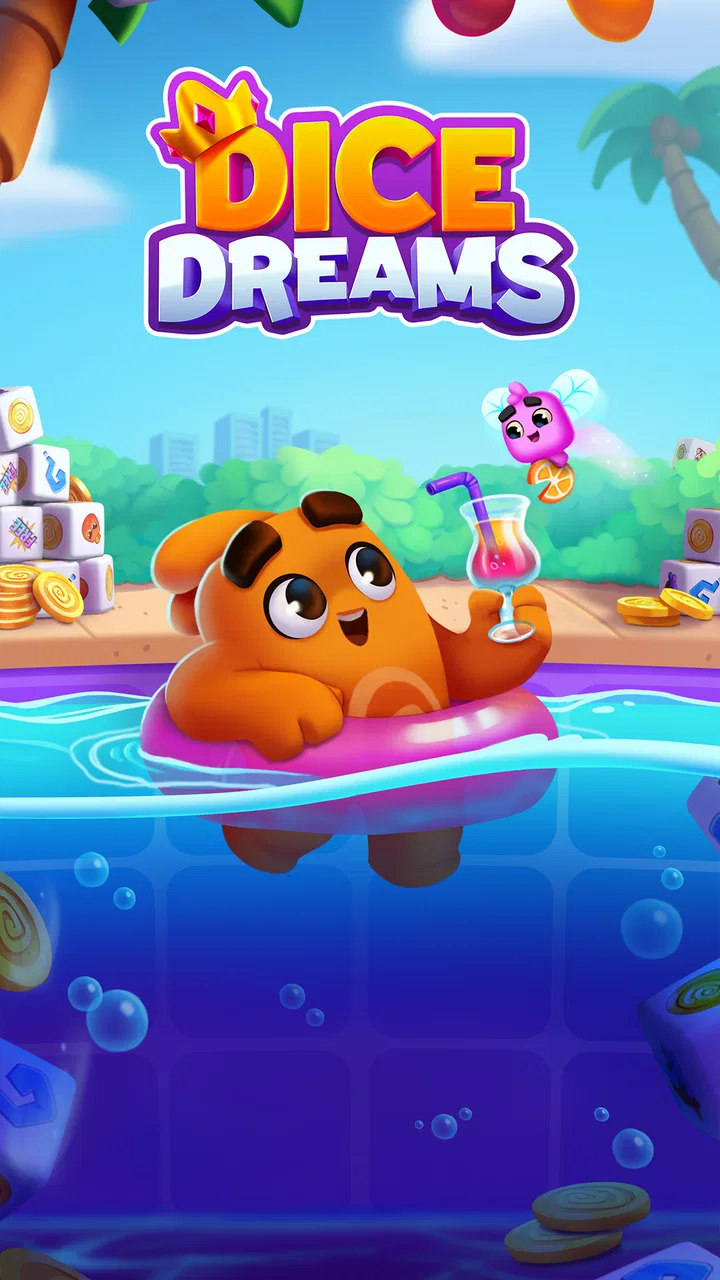
Dice Dreams™️
- 4.7
- Rating
- 50.00M
- Installs
- Free
- Price

 Analysis by App-foxy
I found Dice Dreams™️ easy to understand within a few minutes, but its real appeal is not simply rolling dice. It turns short bursts of play into a social board-game routine, with coins, progress, and interaction with friends tied together in a bright casual format. I can see why it has reached a 4.7 average from around 1.9 million ratings and more than 50 million installs. At the same time, its cheerful presentation hides a few practical issues: the experience depends heavily on waiting for more rolls, social activity can become part of the pressure to return, and optional purchases can become expensive. My overall view is positive for people who enjoy light, repeatable mobile games, especially when they want something less demanding than a strategy title.
How the game feels to read and navigate
The basic loop is approachable. I roll, watch the result affect my board, collect coins, and decide whether to continue with the resources available. That structure makes the game suitable for someone who does not want a long tutorial or a complicated set of menus. The casual category is a good fit because Dice Dreams™️ focuses on quick decisions and familiar board-game ideas rather than deep rules that require study.
The visual presentation is deliberately lively, with animated results and a playful world built around the dice. That energy helps the game feel active even when my decision-making is limited. However, constant movement and decorative effects can also compete with the information I actually need. If you prefer a quiet interface where every button has a restrained appearance, this may feel busy. I found that I needed to pay attention to the current reward, available roll, and next action instead of treating every animation as useful information.
You May Also Like

 Blood Strike: 2.5 Anniversary
Blood Strike’s Loadouts Turn Every Drop Into a Tactical Gamble
A close look at Blood Strike’s custom loadouts: how fast access to signature weapons reshapes its battle royale rhythm, rewards preparation, and narrows the gap between fights.

 Pandora - Music & Podcasts
Pandora’s Music Is Easy to Start, but Harder to Recover
Pandora’s strength is its low-effort path from a seed to a station. Its weak spot is how much confidence it asks you to place in connection, setup, and quiet recovery.

 8 Ball Pool
 Is Built on Rivalries, Rematches, and Routine
A close look at the rivalries, rematches, shared routines, and unanswered safety questions that turn a quick pool match into a persistent mobile community.

 Samsung Music
’s Quiet Strength Is Playing What You Already Own
Its reach comes less from spectacle than from dependable access to a personal library. That simplicity is both the app’s strongest retention engine and its ceiling.

 AccuWeather: Weather Radar
AccuWeather Review: A Quick, Clear Forecast for Everyday Decisions
For everyday plans, the best forecast is the one you can understand quickly. AccuWeather makes rain timing, radar, and local conditions easy to act on, with a few trade-offs.

 Hill Climb Racing
Why Hill Climb Racing Still Turns Crashes Into One More Run
A tiny car, a bumpy hill and one more upgrade: Hill Climb Racing keeps resurfacing because its simple chaos makes every near-miss feel personal.
More From Our News Desk
View All News


Navigation is strongest when I am following the intended path: roll, observe the outcome, collect the result, and move forward. It is less comfortable when I want to pause and inspect everything before acting. The game encourages momentum, so a player who likes to examine menus, compare every option, or plan several turns ahead may feel that the interface is designed more for flow than reflection.
That distinction matters for different reading abilities. A player who understands icons and short prompts quickly can move through the game comfortably. Someone who needs more time to process changing information may find the animated presentation tiring. I would recommend playing the first session slowly, resisting the urge to tap through every reward immediately. That makes it easier to learn which parts deserve attention and which are mostly decoration.
Learning the board without feeling lost
One useful strength is the clear relationship between the roll and the board activity. I do not need to memorize a large rulebook to understand the immediate consequence of a turn. This makes the game a reasonable choice for family members who are comfortable with simple mobile controls but do not usually play games.
There is still a difference between understanding the next move and understanding the long-term economy. Coins, rolls, rewards, and social interactions can make the larger progression feel less obvious than the first few turns. I suggest treating the early play as orientation rather than trying to optimize every reward. Once the rhythm becomes familiar, it is easier to decide whether a particular bonus is worth pursuing or whether I am simply being encouraged to keep playing.
The developer, SuperPlay, has positioned the experience around social board-game entertainment rather than a demanding competitive simulation. That makes the learning curve friendly, but it also means that players looking for precise strategy should lower their expectations. The fun comes from anticipation and accumulation, not from having complete control over every outcome.
Controls, timing, and different motor needs
Dice Dreams™️ is built around taps, which keeps the physical interaction straightforward. I do not need a virtual joystick, rapid button combinations, or accurate aiming. For many players, that is a meaningful advantage: a short tap is easier to manage than the constant hand movement required by action games.
Even so, simple controls are not automatically comfortable for everyone. Animated sequences may invite quick tapping, and a player with limited dexterity may prefer to wait until the screen settles before choosing the next action. My practical advice is to use deliberate taps instead of trying to keep pace with the animation. The game is casual enough that rushing usually adds stress rather than improving the result.
There is also a useful distinction between control difficulty and attention difficulty. The physical action is light, but the screen can present several competing reasons to continue. Someone managing fatigue, tremors, or concentration limits may find the short sessions manageable, yet still feel worn down by repeated prompts and visual activity. In that situation, playing one small session and closing the game is more comfortable than trying to empty every available roll in one sitting.
Players who need a game that can be played almost entirely with one hand may appreciate the compact tap-based loop, although comfort will depend on the device and personal setup. I would not describe the game as a specialist accessibility tool, but it asks less physical precision than many popular alternatives. That is a genuine strength, provided the player is comfortable with the pace of the presentation.
Sound, motion, and sensory comfort
The lively style is part of the identity, but it will not suit every sensory preference. Bright animation, reward feedback, and repeated movement can make a successful turn feel satisfying; they can also become distracting during a longer session. I tend to enjoy the energy in short bursts and notice the clutter more when I keep playing beyond that point.
If motion or visual stimulation is uncomfortable, the safest approach is to test the game in a quiet moment and stop as soon as the presentation becomes tiring. I would not choose it as a calming game. A minimalist puzzle or a turn-based title with a calmer screen may be better for someone who needs low stimulation, even if those games offer less social excitement.
Sound can also affect whether the experience works in a particular setting. A player using the game during a commute, in a waiting room, or beside someone who is sleeping may need to rely on the phone’s normal sound controls. The game is more suitable for those contexts when treated as a silent visual activity rather than something to play with full audio. That is a situational consideration, not a criticism of the core design.
Short sessions, shared play, and everyday situations
The strongest everyday use case is a spare five or ten minutes. I can imagine opening it while waiting for an appointment, taking a few turns during a lunch break, or playing briefly while a friend is also online. The game does not demand the uninterrupted attention of a long campaign, and that makes it easier to fit around ordinary routines.
The social layer gives those short sessions more personality. Playing around friends can make a random roll feel connected to something beyond my own board. It also changes the mood from a solitary time-killer to a lightweight shared activity. For families, this can be a simple way to compare progress or exchange reactions without arranging a full board-game night.
That same social design may not suit everyone. If I prefer games that never draw attention to other players, or if social prompts feel like pressure, the experience can become less relaxing. I would choose a private puzzle game instead when I want complete separation from friends, invitations, and competitive comparison.
The game is free to download, which lowers the barrier to trying it. It is rated for Everyone, so its broad presentation is appropriate for a general audience. Parents should still remember that an age rating describes the intended content level, not whether the reward loop will suit every child’s habits. I would set clear expectations around play time and optional spending before handing the device to a younger player.
Where the economy changes the experience
The central trade-off is the relationship between rolls and progression. Rolling feels exciting because it can produce an immediate change on the board, but the supply of turns shapes how long I can play. When the available rolls run out, the natural impulse is to wait, return later, or look at an optional purchase. That structure is common in free casual games, yet it is important to recognize it before becoming invested.
In-app purchases range from $0.49 to $349.99 per item. The low entry point may make a small convenience purchase seem harmless, while the high upper end is a strong reason to use device spending controls. I would not recommend buying anything during a moment of frustration after an unlucky roll. The better habit is to decide in advance whether the game is worth any spending at all and treat purchases as optional entertainment, never as a way to recover progress.
This is also where Dice Dreams™️ differs from a traditional physical board game. With a tabletop game, the box usually defines the cost and the group controls the pace. Here, the free download makes starting easier, but the ongoing loop can encourage repeated returns and optional spending. A paid offline game may be a better choice for someone who wants a fixed-cost experience with no waiting economy.
My practical tip is to play without spending through the first several sessions. That reveals whether the basic loop itself is enjoyable. If the game only feels satisfying when progress is accelerated, it is probably not the right match. If the free rhythm remains entertaining, optional purchases can stay exactly that: optional.
What it does well for inclusive play
Dice Dreams™️ has several qualities that help it reach different kinds of players. The rules are lighter than those of a strategy board game, the controls are based on simple taps, and the sessions can be divided into small pieces. Those choices make it approachable for people who may not have the energy, time, or physical comfort for a demanding action game.
It can also work as a bridge between experienced and inexperienced players. A regular mobile gamer can understand the reward loop quickly, while a newcomer can participate without learning a large collection of controls. That is particularly useful when friends or relatives have very different gaming backgrounds.
The social format may support connection without requiring everyone to be present at the same time. I can take a turn when convenient and return later, which is easier than coordinating a complete multiplayer match. For people with unpredictable schedules, that flexibility is more realistic than a game built around fixed live sessions.
There are limits to that inclusiveness. The visual busyness may be difficult for players who need calm presentation, and the ongoing reward cycle may be uncomfortable for anyone sensitive to repeated prompts or spending pressure. A player who needs detailed control over pace, display, or interaction style should test the game carefully rather than assuming that a casual label guarantees a comfortable experience.
Performance expectations and version details
The current version is 1.103.0.33228, and the game supports devices running Android 7.0 or later. That makes the operating-system requirement relatively broad for Android users, although the actual experience can still vary with screen size, device performance, and how comfortably the animations display on a particular phone.
I would use a stable connection when possible, especially when playing socially or collecting progress. A casual game can feel surprisingly frustrating if an interruption happens at the exact moment a reward is being processed. For travel or unreliable service, I would not depend on it as my only source of entertainment. An offline-friendly alternative is safer when continuity matters.
Storage, battery use, and responsiveness are also worth considering in everyday use. Animated social games can feel heavier than a simple number puzzle, particularly on an older device. If the phone already struggles with other games, I would try Dice Dreams™️ before making it a regular part of the routine. The broad Android support is helpful, but it should not be confused with identical performance on every compatible device.
Who should choose it, and who should skip it
I would recommend it to someone who likes colorful board-game ideas, enjoys collecting coins, and wants a game that can be opened for a few minutes at a time. It is especially suitable for friends who enjoy checking one another’s progress without committing to a full real-time match. Newer players may also appreciate that the immediate rules are easy to grasp.
I would be more cautious about recommending it to someone who dislikes waiting for turns, wants a completely predictable strategy experience, or prefers to pay once and avoid in-app economies. It is also not my first choice for players seeking a quiet, low-motion interface. A traditional digital board game is better when the goal is deliberate planning, while a puzzle game is better when the goal is calm concentration.
Players who are easily drawn into “one more turn” loops should set a session limit before opening the app. That is not necessary because the game is unusually difficult; it is useful because the reward structure makes returning feel natural. A timer, spending restriction, or simple rule such as “play only while waiting” can keep the experience in its intended casual role.
My inclusive verdict after playing
Dice Dreams™️ succeeds as a friendly, low-pressure-looking board-game experience with a social center. I like that it does not require fast reflexes or a large amount of gaming knowledge, and I can see its value in short, ordinary moments when I want something more engaging than scrolling. Its broad age rating, free starting point, and simple tap-based interaction make it approachable for many players.
Still, approachability is not the same as universal comfort. The animated screen can be demanding for some sensory preferences, the pace can encourage repeated returns, and the purchase range deserves serious attention. The game is at its best when I treat it as a small break rather than a daily obligation or a competition that must be funded.
My honest recommendation is to try it free, play in short sessions, and decide based on the unhurried core loop. If rolling, collecting, and sharing progress with friends remain fun without spending, it can become a pleasant casual companion. If waiting, visual activity, or social pressure gets in the way, a calmer or fixed-cost alternative will serve you better. SuperPlay has made an inviting game for a wide audience, but the right audience is still the player who enjoys its rhythm on their own terms.
FAQs for Dice Dreams™️
01What is Dice Dreams™️ about?
Dice Dreams™️ is a fun and engaging mobile game where players roll dice to progress through a colorful and whimsical world. You build and upgrade your kingdom while competing against friends and other players. The game combines elements of strategy, chance, and social interaction, making it both exciting and unpredictable.
02Is Dice Dreams™️ free to play?
Yes, Dice Dreams™️ is free to download and play on both Android and iOS devices. However, it does offer in-app purchases for players who wish to enhance their gaming experience. These purchases can include extra dice rolls, additional resources, or special items to aid in kingdom development.
03How do I earn more dice rolls in Dice Dreams™️?
In Dice Dreams™️, players can earn more dice rolls by leveling up, completing quests, or participating in daily challenges. Additionally, players can receive extra rolls through rewards, bonuses, or by purchasing them via in-app transactions. Engaging with the game regularly often provides more opportunities to earn dice.
04Can I play Dice Dreams™️ with friends?
Absolutely! Dice Dreams™️ encourages social interaction by allowing players to connect with friends. You can challenge friends, compete in leaderboards, and even team up to take on special events. The game integrates social media connectivity, making it easy to invite friends and share your progress.
05What should I do if I encounter technical issues with Dice Dreams™️?
If you experience technical problems with Dice Dreams™️, the first step is to check for updates and ensure you have the latest version of the app. If the issue persists, you can contact the game's support team through the app or the official website. Providing details about the problem can help the support team assist you more effectively.
Pros
- Engaging gameplay with colorful graphics.
- Simple mechanics suitable for all ages.
- Regular updates with new features.
- Multiplayer mode enhances social interaction.
- Free to play with optional in-app purchases.
Cons
- Can be addictive
- consuming much time.
- Requires constant internet connection.
- Some features locked behind paywalls.
- Occasional in-game ads can be disruptive.
- Limited offline play options.

Dice Dreams™️
Gallery